How to Improve Communication Between the District Office and Schools
TL; DR:
When communication breaks down between the district office and individual schools, families pay the price: inconsistent updates, mixed messages, and a feeling that no one is on the same page. A shared communication system with clear expectations and flexible tools closes that gap, without turning every principal into a brand compliance officer.
The district office sends a newsletter. The school sends its own version. A classroom teacher sends something different entirely. By the time a family pieces it all together, they’re not sure what’s accurate, what’s optional, or who to call.
It happens all over, and it starts the same way: no one built a system, so everyone built their own.
Why the gap exists
The district office and individual schools have genuinely different jobs. The district communicates policy, budget decisions, and systemwide initiatives. Schools communicate what’s happening this week, in this building, for these families. Both are essential. Both happen on different timelines, with different urgencies, and often with different tools.
Without a structure that connects those layers, everyone improvises. Principals make judgment calls about what to share and when. Teachers fill the vacuum with their own updates. And families develop wildly different pictures of what’s happening in their district, depending on which school their child attends.
Consistency means families receive the same core information, regardless of which school they call home.
What alignment actually looks like
Effective district-to-school communication gives every building a shared structure and the latitude to use it their own way.
That looks like:
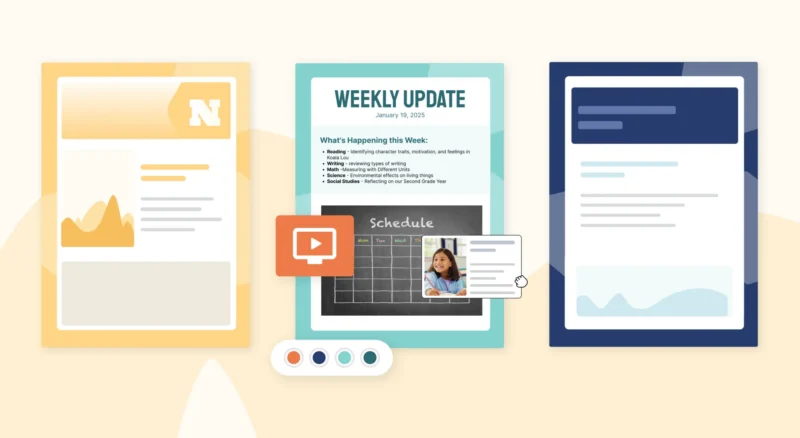
- A district-approved newsletter template that includes required sections (key dates, district updates, contacts) and room for schools to personalize everything else
- A consistent send cadence (weekly, biweekly, monthly) that families learn to expect
- Clear guidance on which content comes from the district level and which lives at the school level
When the structure is clear, principals spend less time figuring out what to say and more time making it worth reading. Communication becomes a system.
Where tools do the heavy lifting
A system only holds if the tools support it. Asking 40 principals to maintain brand consistency using 40 different workflows is a governance challenge that no amount of professional development will solve.
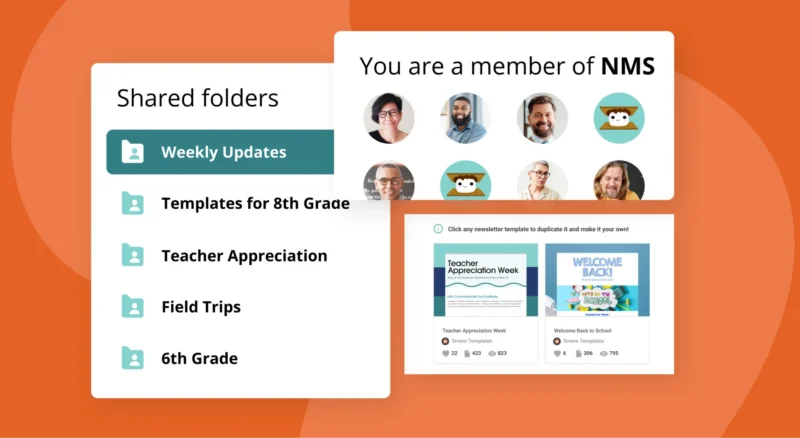
Shared communication platforms give district leaders visibility into what is going out and when, without requiring them to approve every message. Principals see templates and work within them. The district office can push out required content directly. Analytics show who is opening newsletters and what content resonates, so leaders can improve in real time instead of guessing.
That feedback loop is fundamental to progress. A comms director who can see exactly which schools are reaching families and which ones are not can actually do something about it. Without that data, everyone just assumes things are fine until a school board meeting proves otherwise.
The question of voice
Here is where district administrators sometimes hesitate: they worry that standardization will flatten the personality that makes each school’s communication feel alive. That concern is worth taking seriously.
Strong district communication frameworks protect local voice. A template sets the structure. The principal, teacher, or communications staff fills it with their school’s stories, photos, and community updates. The family reading School A’s newsletter knows exactly where to find the important dates, and also gets a glimpse into what makes School A different from every other building in the district.
Structure makes room for personality.
A practical starting point
If your district is early in building this kind of system, the simplest version of this is a shared template, a recommended cadence, and a brief style guide. You do not need a full communications department to get started.
Start with one or two schools willing to pilot the structure. Get feedback from principals and families. Refine before rolling out district-wide. The districts that do this well treat it as a communication culture shift.
📬 Ready to see how Smore for Teams makes district-to-school communication easier to manage and more consistent to read?
FAQs
Does this mean the district controls what every school sends?

What if principals are already using different tools?
How do you measure whether communication alignment is working?
Can smaller districts benefit from this kind of structure?
What is the biggest mistake districts make when trying to improve internal communication?