Example Newsletter for Parents from a Teacher: What to Include and How to Send It
TL; DR
Looking for an example of a teacher-to-parent newsletter? This post breaks down what to include, shares real examples across grade levels (elementary, middle school, and high school), and provides a free template to help you communicate with families in a way that’s clear, helpful, and easy to create.
Communicating with families is one of those things that everyone agrees is important—but no one tells you exactly how to do it.
What should you include? How long should it be? What tone should you use? And how do you make sure families actually read it?
If you’re looking for a real example of a teacher-to-parent newsletter—plus tips to make your own communication easier—you’re in the right place.
What Should a Newsletter from a Teacher to Parents Include?
A great parent newsletter doesn’t need to be long or fancy. It just needs to be clear, helpful, and easy to read. Here’s what works:
1. A Friendly Greeting
Start with a warm, personal welcome. This sets the tone and helps families feel connected to you and your classroom.
2. Classroom Updates
Give families a snapshot of what’s happening—what you’re learning, recent projects, or skills students are practicing.
3. Student Highlights
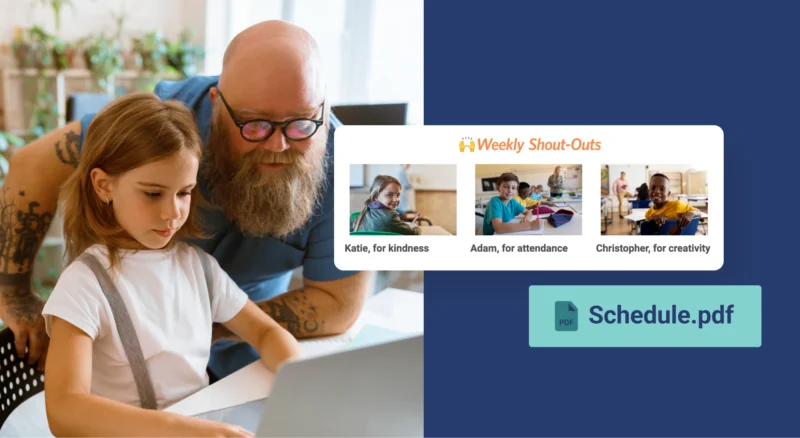
Celebrate students through academic achievements, kind actions, or moments that made you smile. Rotate who gets highlighted to keep it inclusive.
4. Upcoming Events or Important Dates
Let families know what’s on the calendar so they can plan ahead.
5. Ways to Support Learning at Home
Give families simple, actionable ideas for reinforcing what students are learning.
6. Quick Reminders
Use this space for practical info like supply needs, schedule changes, or forms that are due.
Example Newsletter for Parents from a Teacher (Elementary/Weekly Format)
Here’s what a weekly teacher-to-parent newsletter might look like:
Subject Line: Week of October 9: What We’re Learning + Upcoming Events
Dear Families,
Happy October! I hope you all had a great weekend. We had such a wonderful week in class, and I’m excited to share what we’ve been working on.
What We’re Learning:
- Reading: We’re exploring character traits and making predictions as we read our new class novel.
- Math: Students are learning about fractions using hands-on manipulatives—it’s been so much fun!
- Science: We started our plant growth experiment. Ask your child what they think will happen next!
Student Highlights: A big shoutout to Emma for helping a classmate during group work, and to Jordan for showing incredible focus during independent reading time. I’m so proud of the kindness and effort I’m seeing every day!
Upcoming This Week:
- Tuesday: Library day—please return books
- Thursday: Math quiz on multiplication facts
- Friday: Show and Tell (bring something that starts with the letter “C”)
How to Support Learning at Home:
- Practice skip counting by 2s, 5s, and 10s.
- Read together for 15 minutes each night.
- Ask your child to teach you one thing they learned this week.
Quick Reminders:
- Please send a water bottle and snack each day.
- We’re running low on tissues—if you’re able to send some in, we’d really appreciate it!
As always, feel free to reach out if you have any questions. I’m here to support your child’s learning every step of the way.
Warm regards,
Ms. Johnson
Why this example works:
- It’s short and easy to scan
- It includes the most important info without overwhelming families
- It’s warm and personal, not formal or stiff
- It invites families to be part of the learning process
- It gives specific, actionable ways to help at home
Example Newsletter for Parents from a Teacher (Elementary/Monthly Format)
Monthly newsletters can go a bit deeper since you’re covering more ground. Here’s an example:
Subject Line: October in Room 12: What We’re Learning This Month
Dear Families,
Welcome to October! I can’t believe we’re already a month into the school year. Students are settling in beautifully, and I’m excited to share what’s ahead this month.
October Learning Focus:
This month, we’re diving into some exciting topics across all subjects:
- Reading: We’re exploring poetry and figurative language. Students will learn to identify similes, metaphors, and personification.
- Math: Our focus is fractions—understanding equal parts, comparing fractions, and adding fractions with like denominators.
- Science: We’re studying the life cycle of plants. Each student will grow their own bean plant and document its growth in a science journal.
- Social Studies: We’re learning about community helpers and the important roles people play in our neighborhood.
Student Spotlight:
This month, I’m excited to introduce you to Marcus! Marcus loves science experiments and is always asking thoughtful questions. He’s been working hard on his reading fluency and has made incredible progress this month. Ask him about his favorite part of our plant experiment!
October Calendar:
- Oct 6: Fall field trip to the pumpkin patch (permission slips due Oct 3)
- Oct 13: Picture day
- Oct 20-21: Parent-teacher conferences
- Oct 27: Fall harvest celebration in our classroom
- Oct 31: Halloween dress-up day (costumes welcome!)
Classroom Highlights:
This month, students created self-portraits inspired by different artists. The creativity and attention to detail were amazing! We also launched our “Kindness Challenge” where students are catching each other doing kind things. So far, we’ve recorded over 50 acts of kindness!
Try This at Home in October:
- Visit your local library and check out books about fall or poetry
- Practice identifying fractions in everyday life (pizza slices, cutting sandwiches, etc.)
- Go on a nature walk and collect fall leaves—then sort them by size, color, or shape
- Read together for 20 minutes each night
Volunteer Opportunities: We’d love your help! We’re looking for volunteers to:
- Chaperone our field trip on Oct 6
- Help with our fall celebration on Oct 27
Reminders:
- Please check backpacks daily for important papers
- Send a water bottle and healthy snack each day
- Library books are due every Friday
Thank you for being such wonderful partners in your child’s education. If you have any questions or concerns, please don’t hesitate to reach out. I’m always happy to chat!
Warm regards,
Ms. Thompson
Why this monthly example works:
- It gives the big picture for the whole month
- It includes more detail and storytelling than a weekly update
- It creates multiple opportunities for family involvement
- It celebrates classroom community and student growth
Example Newsletter for Middle School (Subject-Specific)
Middle school is when chronic absenteeism often begins to take hold. As students gain more independence, families sometimes feel less connected to what’s happening in the classroom—and that distance can contribute to attendance challenges.
Regular, thoughtful communication helps bridge that gap. When families understand what their student is learning and why it matters, they’re more likely to prioritize attendance and reach out early when issues arise. A direct line to parents during these critical years can make all the difference.
Here’s how a subject-specific newsletter might look:
Subject Line: 7th Grade Science: October Update
Dear Families,
Happy October! This month in 7th grade science, we’re exploring some fascinating topics. Here’s what your student is learning and how you can support them at home.
What We’re Learning:
This month, we’re diving into the structure and function of cells. Students will:
- Identify the parts of plant and animal cells
- Understand how organelles work together
- Build 3D cell models (project due Oct 25)
- Complete a lab on osmosis and diffusion
Why This Unit Matters:
Understanding cells is foundational for everything we’ll study this year in biology. The lab work we’re doing helps students develop scientific thinking skills they’ll use throughout middle and high school. Consistent attendance is especially important during labs—these hands-on experiences can’t be fully replicated with make-up work.
Upcoming Assessments:
- Oct 12: Cell parts quiz
- Oct 19: Lab practical
- Oct 25: Cell model project due
If Your Student Has Been Absent:
I know illnesses happen! If your student has missed class:
- Have them check our class website for notes and assignment details
- Encourage them to email me with questions
- Remind them they can attend Tuesday/Thursday study sessions (2:45-3:15) for extra help
Missing a few days can make it harder to keep up, so please reach out if your student needs support getting back on track.
Ways to Support Learning at Home:
- Quiz your student on cell parts using flashcards (they have a set in their science notebook)
- Watch videos together about cells—I recommend Crash Course Biology or Amoeba Sisters on YouTube
- Help your student plan their cell model project (it can be edible, built from craft materials, or digitally created)
- Ask them to explain what they learned in lab this week
Reminders:
- Lab safety contracts were sent home last week—please sign and return
- Science fair information will be sent home next week for students who are interested
Let’s Stay Connected:
Middle school is such an important time, and I want to make sure we’re partners in your student’s success. If you have questions about your student’s progress, the cell model project, or anything else, please don’t hesitate to reach out. I’m here to help.
Best,
Mr. Chen
7th Grade Science
[Email] | Office hours: Tues/Thurs 2:45-3:15
Why this middle school example works:
- It acknowledges that middle school is when attendance patterns often shift
- It creates a direct, open line of communication between teacher and parents
- It explains why attendance matters for this specific unit
- It gives parents concrete action steps if their student has been absent
- The tone is collaborative and inviting, positioning the teacher as a partner during these critical years
Example Newsletter for High School (Class or Grade-Level)
High school communication is especially important. When families understand what students are learning and missing, they’re more likely to support attendance and engagement. Here’s an example:
Subject Line: U.S. History Update: What We’re Covering in October + Why Attendance Matters
Dear Families,
I hope this message finds you well. As we move into October, I wanted to share what we’re covering in U.S. History and why consistent attendance is so important right now.
What We’re Learning This Month:
We’re in the middle of our unit on the Civil War and Reconstruction. Students are:
- Analyzing primary source documents from the era
- Participating in structured debates about states’ rights vs. federal power
- Working on a research project examining the lasting impact of Reconstruction (due Oct 27)
- Preparing for our unit exam on Nov 1
Why Attendance Matters:
This unit builds skills students will need for the rest of the year—and beyond. Class discussions help them develop critical thinking and analyze multiple perspectives. When students miss class, they miss:
- In-depth discussions that can’t be replicated through notes alone
- Collaborative work that builds their research and presentation skills
- Practice with the types of questions they’ll see on exams and standardized tests
If your student has been absent, please have them check our class website for notes and assignments, and encourage them to come to office hours (Tuesdays and Thursdays, 2:45-3:30).
Upcoming Dates:
- Oct 18: Civil War research project checkpoint (in-class peer review)
- Oct 27: Research project due
- Nov 1: Unit exam
How Families Can Help:
Even small conversations make a difference:
- Ask your student what they’re learning about the Civil War. Have them explain a perspective they hadn’t considered before
- Encourage them to attend class consistently, especially during this unit
- Remind them to use office hours if they’re struggling or have missed class
- Help them break their research project into manageable steps
Student Resources:
- All notes and assignments are posted on our class website
- I’m available for extra help during office hours or by appointment
Reminder About Attendance:
I know life gets busy, but please prioritize attendance whenever possible. Students who attend consistently perform significantly better, and the skills we’re building in class are hard to make up independently.
If your student is struggling with attendance due to illness, transportation, or other challenges, please reach out so we can problem-solve together.
Thank you for partnering with me to support your student’s success. Please don’t hesitate to contact me if you have questions or concerns.
Best regards,
Mr. Patterson
U.S. History
[Email] | [Class website]
Office hours: Tuesdays & Thursdays, 2:45-3:30
Why this high school example works:
- It directly addresses attendance and explains why it matters
- It connects learning to real outcomes (skills, exams, college readiness)
- It shows families concrete ways to help, even as students become more independent
- It provides multiple touchpoints for support
- It’s specific about what students are missing when they’re absent—not just content, but discussions and skill-building
How Do Teachers Write Newsletters to Parents?
Writing a newsletter doesn’t have to be time-consuming. Here’s a simple process:
1. Pick a template.
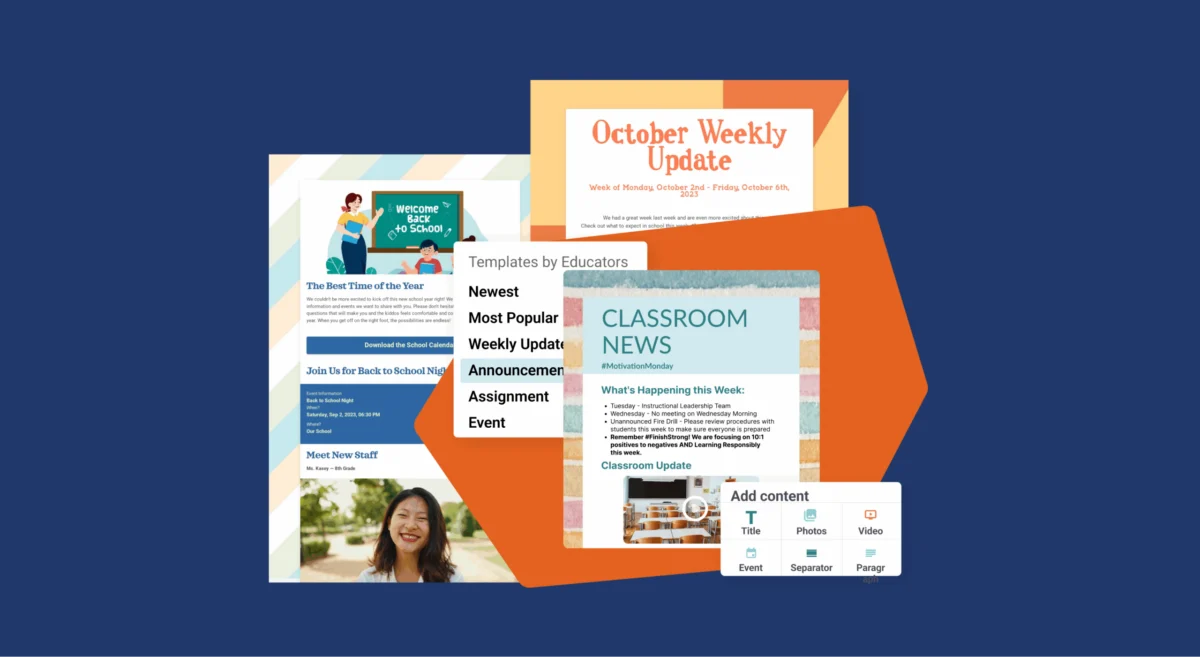
Start with a pre-designed template so you’re not starting from scratch every time. Smore offers templates built specifically for teacher-to-parent communication.
2. Fill in the key sections.
Use the structures above as your guide. You don’t need to reinvent the wheel—just add your own classroom updates.
3. Keep it conversational.
Write like you’re talking to a friend. Families want to hear from you, not read a formal letter.
4. Add visuals.
Include photos of students in action (with permission), student artwork, or graphics to make your newsletter more engaging.
5. Send it consistently.
Pick a day each week or month to send your newsletter and stick with it. Consistency builds trust.
How to Send Your Newsletter
Once your newsletter is ready, how do you get it to families?
Email is the most common method. Tools like Smore make this easy—just hit “send” and your newsletter goes out to your class distribution list.
You can also post on your classroom website so families can access it anytime, send print copies home with students for families who prefer paper, or pair your newsletter with a text message alert for urgent updates.
Pro tip: Smore newsletters are mobile-friendly and include built-in translation, so families can read in their preferred language. This makes it easier to reach every family in your classroom.
Free Template for Teachers
Ready to create your own teacher-to-parent newsletter? Smore offers easy-to-use templates designed specifically for educators.
Here’s what you get:
- Pre-designed layouts that look great on any device
- Drag-and-drop editing so you can customize quickly
- Built-in translation so families can read in their preferred language
- Analytics to see who’s opening and engaging with your newsletters
- Options for weekly, monthly, or occasional updates
You don’t need to be tech-savvy. You don’t need design skills. Just choose a template, add your content, and send.
Start Communicating with Confidence
Parent newsletters don’t have to be perfect—they just need to be helpful, consistent, and genuine. With the right template and a clear structure, you can create newsletters that families look forward to reading and that help you build trust all year long.
Start with one of the examples above, adapt it to fit your classroom and your voice, and you’ll have a communication system that works for everyone.
FAQs
How do teachers write newsletters to parents?

What should a weekly parent newsletter from a teacher include?
Is there a free template for teacher newsletters?
How do I send a newsletter to parents?